


Most car accident claims in Pennsylvania focus on compensatory damages, including medical bills, lost wages, and pain and suffering. Punitive damages are different. Punitive damages punish dangerous driving behavior and deter others from acting with the same disregard for human life. Philadelphia car accident lawyer Jeff Penneys helps families throughout Pennsylvania recover damages after serious accident injuries. In this latest post, he explores punitive damages in car accidents and how Pennsylvania law determines when the standard for damages is met.
The Legal Standard for Punitive Damages in Pennsylvania
Pennsylvania courts reserve punitive damages for outrageous conduct and acts with an evil motive or with reckless indifference to the rights and safety of others. The Pennsylvania Supreme Court crystallized this rule in SHV Coal, Inc. v. Continental Grain Co. (1991), adopting the Restatement (Second) of Torts § 908(2) that states punitive damages are permissible for conduct that is “outrageous, because of the defendant’s evil motive or his reckless indifference to the rights of others.”
Two additional guideposts matter:
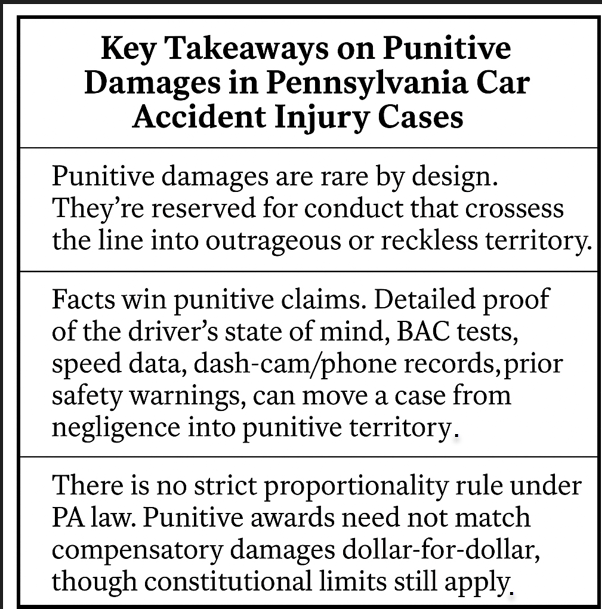
- It’s more than negligence. Gross negligence alone won’t meet the punitive damages standard; there must be a heightened state of mind approaching recklessness. Courts repeatedly stress that mere traffic violations or inattentiveness, standing alone, are not enough.
- Victims must prove subjective appreciation and conscious disregard. In Hutchison v. Luddy (2005), the Supreme Court explained that a plaintiff must show the defendant (a) had a subjective appreciation of the risk of harm, and (b) acted (or failed to act) in conscious disregard of that risk. That mens rea requirement is what separates punitive exposure from ordinary negligence.
Pennsylvania also recognizes that punitive damages are not required to be mathematically proportional to compensatory damages as a matter of state law (see Kirkbride v. Lisbon Contractors, Inc. (1989)).
When Do Drivers Face Punitive Damages in Auto Accident Cases?
Because driving is inherently risky, before deciding on punitive damages, courts look for aggravating facts that show the driver knew there was a high likelihood of serious harm and drove anyway.
Common fact patterns in car accident cases involving punitive damages include:
- Drunk driving (DUI)
Pennsylvania appellate courts have long recognized that operating a vehicle while intoxicated can support punitive damages in the right circumstances. In Focht v. Rabada (1970), the Superior Court addressed punitive damages against a drunk driver—illustrating that intoxication combined with dangerous driving choices may meet the “reckless indifference” threshold.
- Street racing / extreme speeding
Evidence of willful participation in street racing or traveling at grossly excessive speeds in populated areas often supports punitive claims, as it shows a conscious disregard for obvious risks. (Courts apply the SHV Coal/Hutchison standard to assess that state of mind.)
- Hit-and-run with prior dangerous behavior
Fleeing can be an aggravating factor when paired with other types of recklessness (e.g., speeding through a pedestrian zone). The flight itself doesn’t create punitive liability, but it can color the overall picture of indifference.
- Distracted driving with egregious actions
Pennsylvania trial courts have grappled with punitive claims based on texting or device use. The trend is that device use alone may be negligent. Claims for punitive damages require more substantive evidence of egregious actions, such as completely diverting attention at highway speeds, prior warnings, or other reckless choices.
- Commercial drivers ignoring safety rules
For professional drivers, evidence of knowingly violating hours-of-service, cell-phone, or substance rules, especially after prior violations, can satisfy the “subjective appreciation and conscious disregard” test. (Courts still apply Hutchison’s mental-state analysis to the driver and, where alleged, to the employer for independent negligence theories like negligent entrustment/supervision.)
How Courts Evaluate a Punitive Claim
Courts consider the character of the act, the extent of harm, and (at the punitive-assessment stage) the defendant’s wealth, to calibrate deterrence. Plaintiffs strengthen punitive claims by proving:
(1) the driver knew of a serious risk (e.g., obvious intoxication or explicit warnings), and
(2) chose to proceed anyway (e.g., racing through a crowded corridor)
At the pleading stage, Pennsylvania courts often strike boilerplate punitive demands where the complaint alleges only ordinary negligence (e.g., “failed to keep a proper lookout”). Plaintiffs typically can show specific facts that plausibly show recklessness, including:
- The driver’s BAC levels
- Prior driving warnings
- Speed estimates
- Witness accounts of racing
- Dash-cam footage, etc.
Practical Examples of Punitive Damages in Pennsylvania Cases
- High-BAC DUI through a pedestrian zone: A driver leaves a bar visibly intoxicated, blows well over the legal limit, then speeds through a busy crosswalk and strikes a pedestrian. Evidence of obvious impairment plus high-risk driving can satisfy Hutchison’s subjective appreciation/conscious disregard test.
- Street racing on Roosevelt Boulevard: Two drivers agree to race at night on a notoriously dangerous corridor; one loses control and causes a multi-car crash. The willful decision to race in an urban corridor strongly supports punitive exposure.
- Texting at highway speeds despite prior warnings: A delivery driver is repeatedly counseled for device use, signs a company policy acknowledging the danger, and then, while reading messages at 65 mph, rear-ends a stopped vehicle. Those extra facts elevate ordinary distraction into reckless indifference.
Summarizing Pennsylvania’s Approach to Punitive Damages in Car Accident Injury Cases
Request Your Free Consultation with Jeff Penneys for Car Accident Case Analysis
Jeff Penneys has over 30 years of experience winning complex car accident cases involving punitive damages for clients throughout Pennsylvania. If you have any questions about the compensation to which you’re entitled after a serious accident injury, request your free consultation today and speak with Jeff Penneys directly! Call (215) 771-0430 for answers to your punitive damages questions.
Answers to Your Punitive Damages Questions
Are punitive damages capped in Pennsylvania car accident cases?
Not generally. Pennsylvania does not impose a statutory cap on punitive damages in typical auto-injury cases (medical malpractice has special statutory rules not at issue here). Courts will, however, review large awards for constitutional due-process limits.
Do I need to prove more than negligence to get punitive damages?
Yes. You must prove outrageous conduct, either driven by evil motive or reckless indifference. Ordinary negligence, and even “gross” negligence, standing alone, is not enough.
What evidence helps establish punitive damages in a crash case?
High BAC results, eyewitness accounts of racing or extreme speeding, crash-data downloads, cell-phone records showing active texting at the moment of impact, prior employer warnings, and policy acknowledgments can all support the subjective appreciation/conscious disregard elements under Hutchison.
Can texting while driving lead to punitive damages?
Sometimes, but not automatically. Courts often view device use alone as negligence. Punitive claims gain traction when the facts show complete diversion of attention at dangerous speeds, repeated violations, or other compounding reckless choices.
Are punitive damages available against an employer?
Potentially. Although claims like negligent entrustment, hiring, or supervision, if the plaintiff proves the employer’s own conduct meets the punitive standard (or in limited circumstances under agency principles). The same Hutchison mental-state analysis applies.