
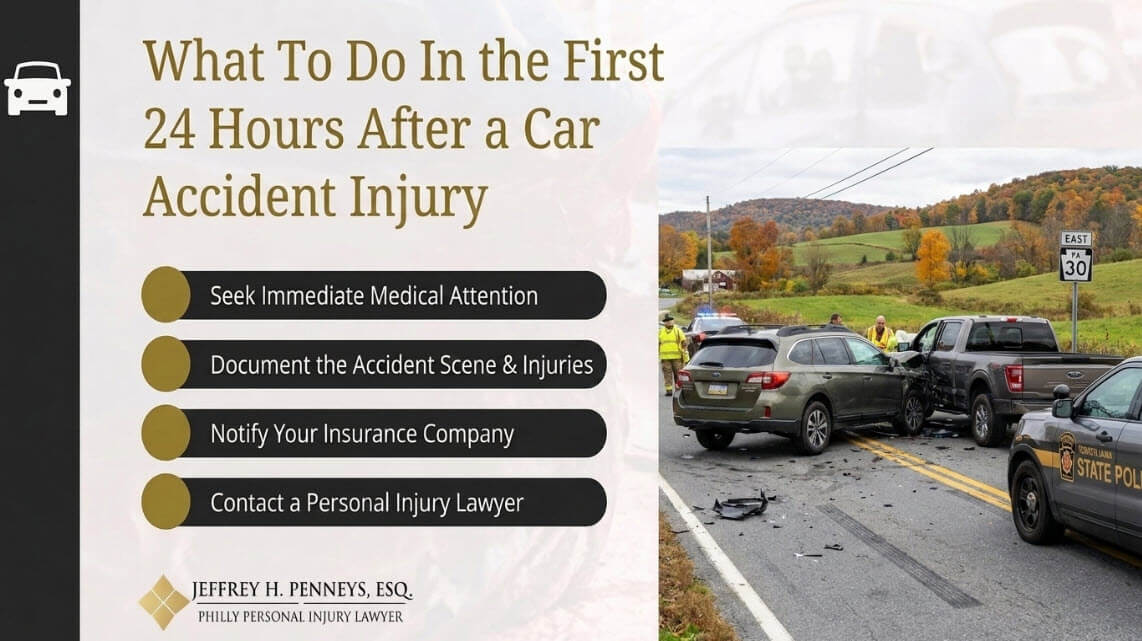
The first 24 hours after a Pennsylvania car accident can affect your medical recovery and your ability to seek compensation. Injuries may become more noticeable after the shock of the collision subsides. Vehicles may be moved, witnesses may leave, surveillance footage may be overwritten, and insurance companies may begin building their files immediately.
Pennsylvania’s automobile insurance system also creates issues that injured drivers, passengers, pedestrians, and bicyclists may not expect. Medical bills are generally submitted through applicable first-party automobile insurance benefits before a liability claim against the responsible driver is resolved.
Taking the following steps can help you protect your health, preserve evidence, and avoid preventable insurance problems.
1. Call 911 and Report the Pennsylvania Car Accident
Call 911 when a Pennsylvania car accident causes an injury, death, or vehicle damage that prevents a vehicle from being driven safely. Under 75 Pa.C.S. § 3746, drivers must immediately notify the nearest authorized police department when a crash results in injury, death, or a vehicle that cannot be driven safely.
Tell the dispatcher where the collision occurred, how many vehicles were involved, and whether anyone needs an ambulance. Do not minimize an injury because you are uncertain about its severity. Head injuries, internal injuries, spinal damage, and soft-tissue injuries may not produce immediate symptoms.
The responding agency may be the Pennsylvania State Police, Philadelphia Police Department, or another municipal police department. The investigating officer may document vehicle positions, driver information, witness statements, road conditions, reported injuries, and apparent traffic violations.
A police report does not conclusively determine legal fault. It can still preserve facts that may become important during an insurance claim or Pennsylvania personal injury lawsuit.
2. Seek Medical Care for Car Accident Injuries
Medical treatment should be your priority after a Pennsylvania collision. Request an ambulance for severe pain, uncontrolled bleeding, confusion, weakness, numbness, loss of consciousness, difficulty breathing, or an inability to move safely.
You should also consider a prompt medical evaluation when your symptoms appear manageable. Adrenaline can temporarily conceal pain. Symptoms of concussions, whiplash, herniated discs, internal injuries, and joint damage may become apparent several hours later.
Tell the medical provider about every symptom and explain that the symptoms began after a motor vehicle accident. This creates a medical record connecting your condition to the collision. Follow all discharge instructions and schedule recommended follow-up appointments.
A delay or unexplained gap in care may allow an insurer to argue that the injury was minor, unrelated to the accident, or caused by another event. Jeff Penneys’ guide to back pain after a rear-end collision explains why spinal symptoms should not be ignored simply because they were not severe at the scene.
3. Remain at the Scene but Move Out of Danger
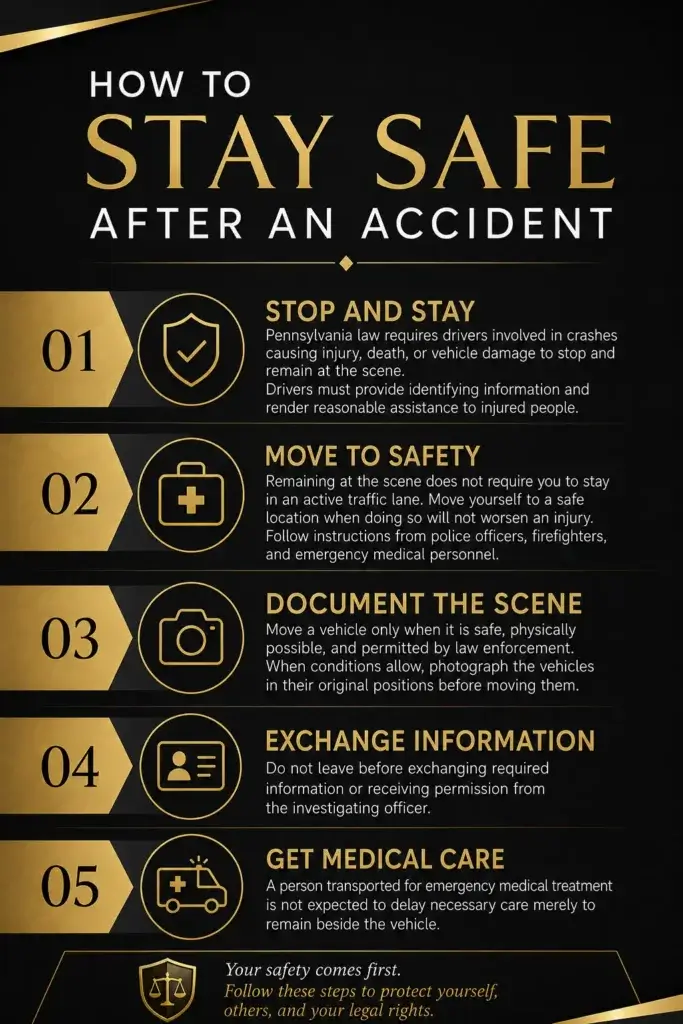
Pennsylvania law requires drivers involved in crashes causing injury, death, or vehicle damage to stop and remain at the scene. Drivers must provide identifying information and render reasonable assistance to injured people.
Remaining at the scene does not require you to stay in an active traffic lane. Move yourself to a safe location when doing so will not worsen an injury. Follow instructions from police officers, firefighters, and emergency medical personnel.
Move a vehicle only when it is safe, physically possible, and permitted by law enforcement. When conditions allow, photograph the vehicles in their original positions before moving them.
Do not leave before exchanging required information or receiving permission from the investigating officer. A person transported for emergency medical treatment is not expected to delay necessary care merely to remain beside the vehicle.
4. Exchange Driver, Vehicle, and Insurance Information
Collect complete information from every driver involved in the Pennsylvania car accident. Photograph the driver’s licence, insurance card, licence plate, vehicle, and registration when possible.
Record the following:
- Driver’s full name and contact information
- Driver’s licence number and issuing state
- Vehicle make, model, colour, and licence plate
- Registered vehicle owner
- Automobile insurance company
- Policy number and expiration date
- Employer or business name when a commercial vehicle is involved
The driver may not own the vehicle. An accident involving a company car, delivery van, rideshare vehicle, rental car, or tractor-trailer may involve additional insurance policies and legally responsible parties.
Do not argue about responsibility or apologize for the collision. Statements such as “I did not see you” or “I must have been going too fast” may later be characterized as admissions, even when you did not have enough information to understand what caused the crash.
5. Photograph the Vehicles, Roadway, and Injuries
Physical conditions can change quickly after a Pennsylvania car accident. Vehicles are towed, debris is removed, weather changes, skid marks fade, and damaged property is repaired.
Below is a checklist for photos to take after a car accident injury:
Photos to Take for Evidence After a Car Accident
Photograph the collision from several safe angles. Nearby businesses, homes, parking lots, buses, and commercial properties may have surveillance cameras. Record the addresses and camera locations so preservation requests can be sent before recordings are deleted.
Keep the original digital files. Original photographs may contain metadata identifying when and where they were created. Avoid relying exclusively on compressed images uploaded to social media or sent through messaging applications.
6. Obtain Witness Contact Information
Independent witnesses can help resolve disagreements about a traffic signal, lane change, right of way, vehicle speed, or distracted driving. Ask each witness for their full name, telephone number, email address, and a brief explanation of what they observed.
Do not assume that every witness will appear in the police report. Some witnesses leave before officers arrive. Others provide limited information that is not included in the final report.
Witness memories become less precise over time. Obtaining accurate contact information during the first 24 hours allows your lawyer or insurance company to secure a detailed statement.
A Pennsylvania car accident lawyer can also send preservation letters to businesses, government agencies, trucking companies, rideshare companies, and other parties that may possess videos, vehicle data, employment records, or electronic communications.
7. Notify Your Automobile Insurance Company
Notify your automobile insurer as soon as reasonably possible. Provide the date, location, vehicles involved, police department, and whether anyone required medical attention. Ask for the claim number, adjuster’s name, and instructions for applying for first-party medical benefits.
Pennsylvania is commonly described as a no-fault state for accident-related medical expenses. This means an injured person generally seeks initial payment of covered medical bills through the applicable automobile insurance policy, regardless of which driver caused the accident.
Pennsylvania automobile policies generally include at least $5,000 in first-party medical benefits. You may have purchased higher medical limits or optional coverage for income loss, funeral expenses, accidental death, uninsured motorists, or underinsured motorists.
Jeff Penneys’ guide explaining how PIP benefits work after a Pennsylvania car accident provides additional information on opening a medical benefits claim and coordinating automobile and health insurance.
Reporting the accident does not require you to accept a settlement or provide a detailed statement before your medical condition is understood.
8. Do Not Give the Other Insurer a Recorded Statement
The other driver’s insurance company may contact you within hours. The adjuster may sound helpful while requesting a recorded statement, medical authorization, vehicle photographs, or an early settlement agreement.
The liability insurer represents the responsible driver and protects the insurer’s financial interests. It does not represent you.
You can provide basic contact information without immediately discussing your injuries or giving a recorded account. Avoid estimating speeds, distances, or percentages of fault. Do not say that you are “fine” merely to be polite. Symptoms that appear minor during the first telephone call may later lead to substantial treatment.
Pennsylvania uses a modified comparative negligence rule. Under 42 Pa.C.S. § 7102, compensation may be reduced according to the injured person’s percentage of responsibility. A person who is more than 50 percent responsible is generally prevented from recovering damages from another party.
9. Check Your Limited Tort or Full Tort Status
Pennsylvania automobile policyholders generally select limited tort or full tort coverage. This selection can affect the right to recover noneconomic damages, including compensation for pain, suffering, inconvenience, and loss of life’s pleasures.
Full tort generally preserves the right to pursue noneconomic damages when another driver causes an injury. Limited tort generally restricts noneconomic damages unless the injury meets Pennsylvania’s serious-injury threshold or a statutory exception applies.
Limited tort does not necessarily eliminate a claim. An injured person may still seek economic damages such as unpaid medical expenses and lost earnings. Full tort rights may also apply because of the severity of the injury or circumstances involving an uninsured driver, impaired driver, vehicle defect, or another statutory exception.
Do not assume that the words “limited tort” on a declarations page end your case. The correct analysis may depend on the policyholder, household relationships, vehicle occupancy, insurance compliance, and specific facts of the collision.
10. Preserve Evidence of Your Financial and Personal Losses
Create a dedicated folder for every document connected to the Pennsylvania car accident. Save medical instructions, bills, prescriptions, insurance letters, towing receipts, storage invoices, repair estimates, rental-car charges, and transportation expenses.
Keep damaged clothing, helmets, glasses, child safety seats, mobile devices, and other physical evidence. Do not repair, sell, or destroy a seriously damaged vehicle before its condition has been documented. Vehicle damage and event data may help establish the direction and force of impact.
Document missed work with pay stubs, schedules, timesheets, tax returns, disability forms, employer correspondence, and medical restrictions. Self-employed accident victims should preserve invoices, contracts, business records, appointment calendars, and evidence of cancelled work.
Write a factual daily account of pain, physical limitations, sleep problems, missed activities, and help received from family members. This record can show how the injuries affect ordinary life between medical appointments.
11. Stay Off Social Media
Avoid posting about the collision, your medical treatment, physical activities, travel, work, or recovery. Insurance adjusters and defence lawyers may review publicly available posts for material they believe contradicts your claim.
A photograph does not need to show strenuous activity to create a dispute. A smiling picture, family gathering, or brief social outing may be presented without context as evidence that your injuries are less limiting than reported.
Ask friends and relatives not to tag you in accident-related posts. Review your privacy settings, but do not assume that privacy settings make information inaccessible.
Do not delete existing content after a claim is anticipated. Deleting potential evidence can create a separate legal problem. Stop creating new posts and discuss any concerning content with your attorney.
12. Contact a Pennsylvania Car Accident Lawyer
Contacting an attorney during the first 24 hours can be important when the accident caused significant injuries, fault is disputed, a commercial vehicle was involved, or insurance coverage is unclear.
A lawyer can investigate the crash, locate witnesses, obtain police records, preserve surveillance footage, examine insurance policies, and communicate with adjusters. Legal counsel can also identify claims involving employers, vehicle owners, motor carriers, rideshare companies, government entities, and manufacturers.
Pennsylvania generally provides two years to file a personal injury lawsuit under 42 Pa.C.S. § 5524. That does not mean an injured person should wait. Evidence can disappear within days, and shorter notice requirements may apply to government-related claims.
Frequently Asked Questions
Do I have to call the police after a Pennsylvania car accident?
Yes, when the collision causes an injury, death, or damage that prevents a vehicle from being driven safely.
Should I see a doctor if I do not feel hurt immediately?
Yes. Concussions, internal injuries, whiplash, and spinal injuries may produce delayed symptoms.
Who pays my medical bills after a Pennsylvania car accident?
The applicable automobile insurance policy generally pays covered medical bills first through Pennsylvania first-party medical benefits.
What is the minimum Pennsylvania medical-benefits coverage?
Pennsylvania automobile policies generally include at least $5,000 in first-party medical benefits.
Does Pennsylvania no-fault insurance prevent me from suing?
No. No-fault rules primarily determine how initial medical expenses are paid. You may still have a liability claim against an at-fault driver.
Can I recover compensation with limited tort?
Yes. Limited tort generally restricts noneconomic damages, but economic damages remain recoverable. A serious injury or statutory exception may also restore full tort rights.
Should I give the other driver’s insurer a recorded statement?
No. Speak with a Pennsylvania car accident lawyer before giving the other driver’s insurer a recorded statement.
Should I sign an insurance release during the first 24 hours?
No. Signing a release may permanently end your claim before the full extent of your injuries is known.
Can I recover compensation if I was partly at fault?
Yes, provided you were not more than 50 percent responsible. Your compensation may be reduced by your percentage of fault.
What evidence should I save?
Save photographs, videos, witness information, damaged property, medical documents, insurance communications, receipts, wage records, and vehicle information.
How long do I have to file a Pennsylvania car accident lawsuit?
The general Pennsylvania personal injury filing deadline is two years from the date of injury. Shorter notice requirements can apply in some cases.
When should I contact a car accident lawyer?
Contact a lawyer promptly when you are injured, liability is disputed, insurance coverage is unclear, or an insurer requests a statement or release.
Call Jeffrey H. Penneys After a Pennsylvania Car Accident
Jeffrey H. Penneys has spent 30 years representing Pennsylvania accident victims and dealing with insurance companies. Jeff provides personal attention throughout the claim and is available 24 hours a day, seven days a week.
Review Jeff Penneys’ car accident case results and learn how his experience has helped injured clients pursue compensation.
There are no upfront attorney fees, and you pay no legal fee unless compensation is recovered. Contact our Philly injury law offices now or call 215-771-0430 for a free, no-obligation consultation.
Legal Sources Cited
Two-Year Limitation, 42 Pa.C.S. § 5524. https://www.legis.state.pa.us/WU01/LI/LI/CT/HTM/42/00.055.024.000..HTM
Comparative Negligence, 42 Pa.C.S. § 7102. https://www.legis.state.pa.us/WU01/LI/LI/CT/HTM/42/00.071.002.000..HTM
Immediate Notice of Accident to Police Department, 75 Pa.C.S. § 3746. https://www.legis.state.pa.us/WU01/LI/LI/CT/HTM/75/00.037.046.000..HTM