
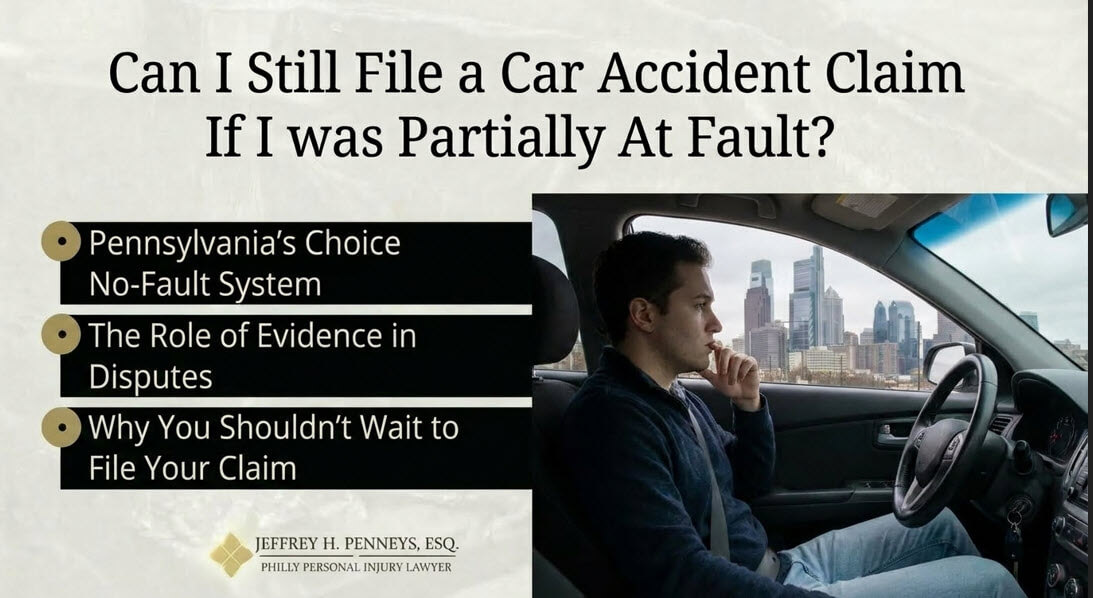
One of the most common questions Pennsylvania car accident victims ask in the days after a crash is whether being partly responsible for what happened disqualifies them from recovering compensation. Insurance adjusters sometimes imply that it does. The short answer is: it doesn’t. Pennsylvania law is designed to protect injured people, even when the situation on the road wasn’t black and white.
Understanding how fault is calculated after a car crash and what it means for your case can make a significant difference to your financial recovery.
How Pennsylvania’s Comparative Negligence Law Works
Pennsylvania follows a modified comparative negligence rule. Under this system, you can still recover compensation for your injuries even if you played a role in causing the accident — as long as your share of the fault does not exceed 50 percent.
The critical factor is how that fault percentage affects your final recovery. If a jury or insurance adjuster determines that you were 20 percent responsible for the crash, your total compensation is reduced by that same 20 percent. So if your damages are valued at $100,000, you would recover $80,000. At 50 percent fault, you would recover half. At 51 percent or more, Pennsylvania law bars you from recovering anything at all.
This rule matters because it keeps the door open for many accident victims who might otherwise assume they have no case. It also means that how fault is assigned carries enormous financial consequences, which is exactly why insurance companies work hard to inflate your share of responsibility.
How Insurance Companies Use Fault Against You
After a car accident, the other driver’s insurance company is not on your side. Their goal is to minimize what they pay out, and one of their most reliable tactics is finding ways to increase their percentage of fault. They may point to your speed, your following distance, whether you signaled, your reaction time, or even your driving history. They do this because every percentage point of fault they can assign to you reduces their payout.
This is also why accepting a recorded statement from an insurance adjuster without speaking to an attorney first is a risk. A single offhand comment — “I didn’t see them coming” or “I may have been going a little fast” — can be used to shift fault in their favor. Once that statement is on record, it is very difficult to walk back.
What Counts as Partial Fault in a Pennsylvania Car Accident?
Fault in a car accident is rarely simple. Pennsylvania courts and insurers consider a range of factors when determining how responsibility is divided between parties. Common scenarios where partial fault might be assigned to an injured driver include situations where one driver ran a yellow light while the other ran red, where a driver was speeding but another made an illegal lane change, or where a distracted driver failed to brake in time, but the other driver reversed without looking. The circumstances of each crash are unique, and the determination of fault often comes down to the quality of evidence, the credibility of witnesses, and the strength of legal representation.
The Role of Evidence in Fault Disputes
Because Pennsylvania’s comparative negligence system makes the exact percentage of fault so consequential, evidence collection is critical. The strongest car accident cases are built on a combination of the following evidence:
- Police reports documenting the scene and the officers’ initial fault assessments
- photographs, and video from dashcams, traffic cameras, or nearby businesses,
- Witness statements gathered at the scene,
- Accident reconstruction expert analysis, where applicable
- Medical records that clearly link your injuries to the crash.
Your attorney’s job is to build the most accurate picture possible of what happened — one that reflects the true share of responsibility on the other driver. The more clearly liability falls on them, the more of your damages you recover.
Pennsylvania’s Choice of Auto Insurance and How It Affects Your Claim
Pennsylvania is a choice no-fault state, which adds another layer of complexity to car accident claims.
When you registered your vehicle, you chose between limited tort and full tort coverage, and that decision affects your right to sue.
If you selected full tort coverage, you retain the unrestricted right to sue the at-fault driver for pain and suffering and other non-economic damages, regardless of the severity of your injury. If you selected limited tort coverage, your right to sue for non-economic damages is restricted unless your injuries meet a defined threshold of severity — which includes serious impairment of a body function, permanent serious disfigurement, or death.
Many people do not remember which option they selected, or did not fully understand the implications when they chose. An experienced car accident attorney can review your policy and advise you on where you stand before you pursue a claim.
What Damages Can You Recover in a Pennsylvania Car Accident Lawsuit?
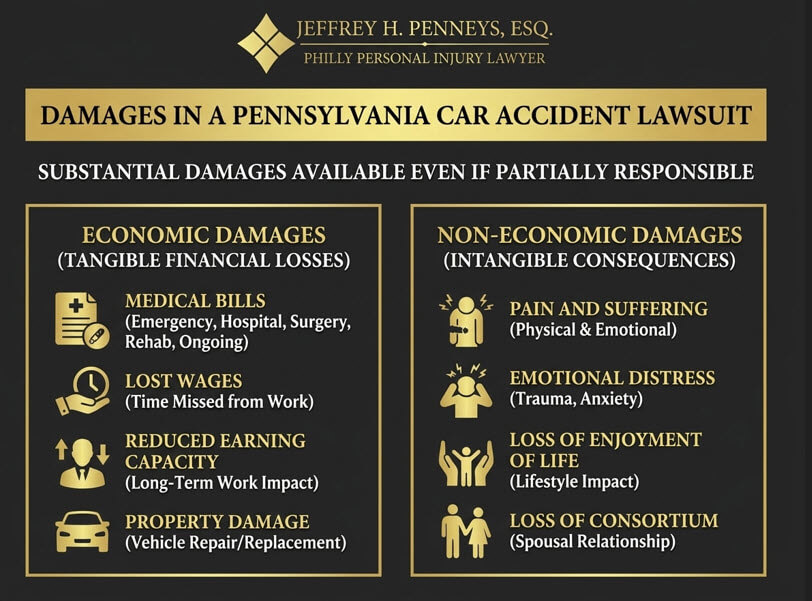
The value of these damages is not fixed. It depends on the severity and permanence of your injuries, the impact on your daily life, your age, your occupation, and the quality of evidence supporting your claim.
Cases involving serious or permanent injuries, significant scarring, or long-term psychological impact tend to result in significantly higher settlements.
Why You Should Not Wait to Call a Car Accident Lawyer
Pennsylvania’s statute of limitations for car accident lawsuits is two years from the date of the crash. Missing that deadline almost always means forfeiting your right to recover compensation entirely. But waiting anywhere near that limit is rarely in your interest. Evidence fades. Witnesses become harder to locate.
The earlier you get an experienced Pennsylvania car accident attorney involved, the stronger your case will be. An attorney can handle all communications with the insurance company, preserve critical evidence, retain expert witnesses where needed, and ensure that every category of damage is properly valued and pursued.
Why Choose Jeff Penneys for Your At-Fault Car Accident Case
- Success with Partial Fault Car Accidents: Proven ability to secure compensation even for clients who initially believed their own partial fault put a settlement out of reach.
- Decades of Experience: Over 30 years of successfully winning car accident cases throughout Pennsylvania.
- Proven Track Record: Millions of dollars recovered for injured clients.
If you have been injured in a car accident and have questions about your rights under Pennsylvania law, you can reach Jeff Penneys any time, 24/7, for a free, no-obligation consultation. You pay no legal fees unless your case is won. Call (215) 259-3703 or book your consultation online.
Answers to Frequently Asked Questions about Fault in Pennsylvania Car Accidents
What happens if I am 50 percent at fault?
If you are found exactly 50 percent at fault, you can still recover compensation — but your award will be reduced by half. If you are found 51 percent or more at fault, Pennsylvania law prevents you from recovering anything from the other driver.
Does it matter which type of auto insurance I have in Pennsylvania?
Yes. Pennsylvania drivers choose between limited tort and full tort coverage. Full tort gives you an unrestricted right to sue for pain and suffering. Limited tort limits that right unless your injuries meet a legal threshold of severity. If you are unsure which option you selected, review your policy or ask an attorney.
What if the other driver also had partial fault — can we both claim against each other?
Yes. In Pennsylvania, fault is apportioned between all parties involved. Each driver may have a claim against the other depending on their respective fault percentages. Your attorney can advise you on how this affects the value of your case.
How long do I have to file a car accident lawsuit in Pennsylvania?
Generally, two years from the date of the accident. Missing this deadline almost always means losing your right to compensation. Do not wait — consult an attorney as soon as possible after the crash.
What if I were injured as a passenger? Am I affected by the driver’s partial fault?
As a passenger, you are generally not considered at fault for the accident unless there are very unusual circumstances. You typically have a right to pursue full compensation from one or both of the drivers involved, depending on how fault is allocated between them.
Will my case have to go to court?
Most Pennsylvania car accident cases settle before reaching trial. However, if the insurance company refuses to offer fair compensation, Jeffrey Penneys is an experienced trial lawyer who will not hesitate to take your case to court to fight for what you deserve.
What does it cost to hire a car accident lawyer in Pennsylvania?
Jeffrey Penneys handles all car accident cases on a contingency fee basis, meaning there are no upfront costs and no legal fees unless your case results in a settlement or court award. Your initial consultation is always free.